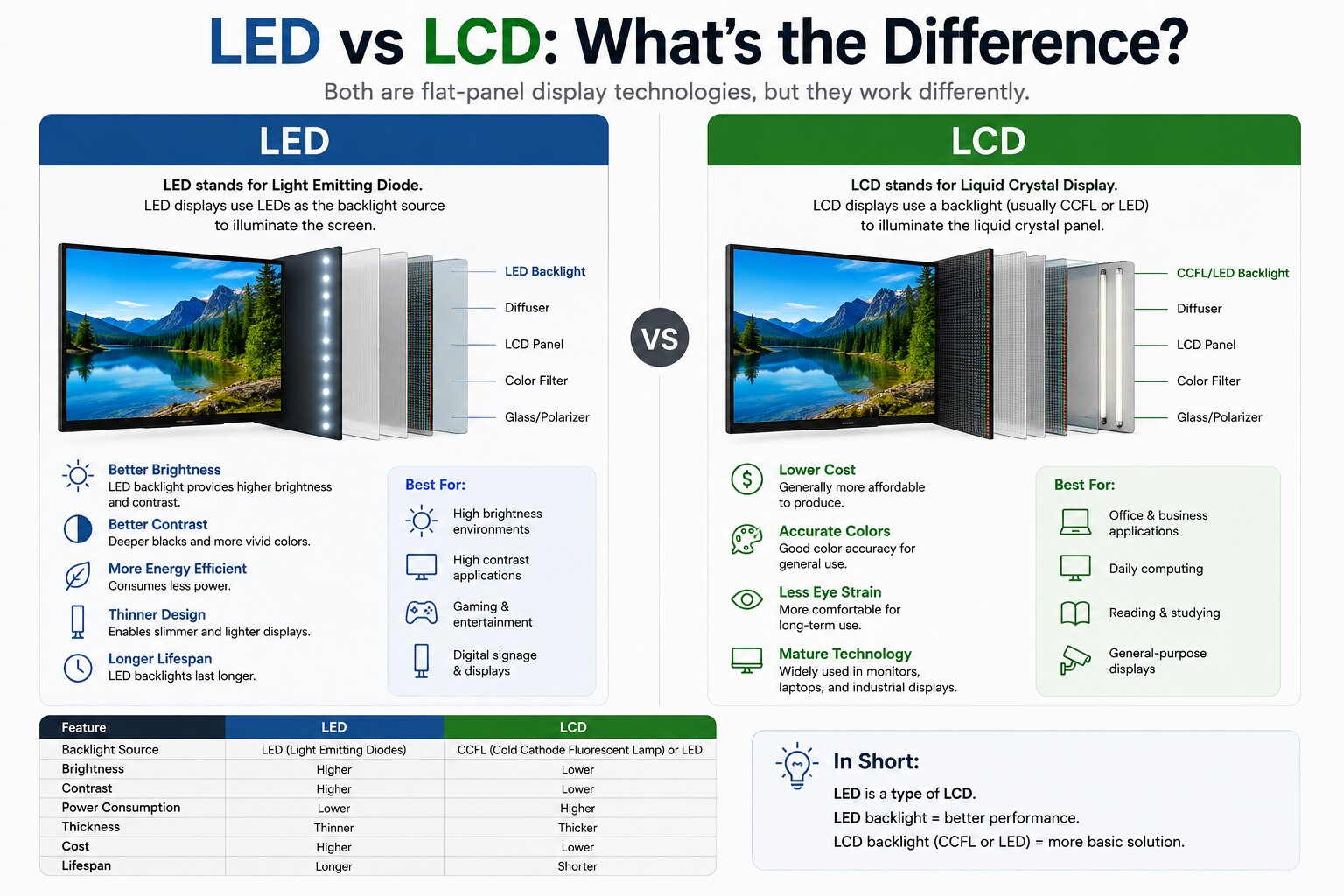
Digital signage has become one of the most effective tools for modern business communication. From retail stores and shopping malls to restaurants, airports, hospitals and corporate offices, commercial displays help companies deliver dynamic content, improve customer engagement and strengthen brand visibility.
However, one of the most common questions buyers ask is:
Should I choose an LCD display or an LED display?
Although these two technologies are often compared, many people misunderstand their differences. Some believe LCD and LED are completely different display technologies, while others assume LED is always the better option.
The reality is more nuanced.
Choosing the right display depends on factors such as viewing distance, installation environment, budget, brightness requirements, operating hours and the type of content you plan to display.
In this guide, we'll explain everything you need to know about LCD and LED digital signage, helping you make an informed purchasing decision for your next commercial project.
📌 Key Takeaways
- LCD and LED displays serve different commercial applications.
- LCD digital signage offers excellent image quality and cost efficiency for indoor environments.
- LED displays provide exceptional brightness and are ideal for large outdoor installations.
- Viewing distance plays a crucial role when selecting display technology.
- Understanding your project requirements is more important than simply choosing the newest technology.
What is LCD Digital Signage?
LCD (Liquid Crystal Display) digital signage uses liquid crystal technology combined with LED backlighting to produce bright, sharp and colorful images.
Modern commercial LCD displays offer:
- Full HD and 4K resolution
- IPS wide viewing angles
- Android operating systems
- Touch screen options
- 24/7 commercial operation
- Remote content management
- Low power consumption
LCD displays are commonly used in:
- Retail stores
- Shopping malls
- Restaurants
- Hotels
- Meeting rooms
- Hospitals
- Schools
- Airports
- Smart offices
Because of their high pixel density and sharp image quality, LCD displays are ideal for applications where viewers are relatively close to the screen.
What is LED Digital Signage?
LED digital signage consists of thousands or even millions of individual light-emitting diodes arranged into large display panels.
Unlike LCD displays, LED displays do not use liquid crystal panels. Instead, each LED produces its own light, making the display significantly brighter and easier to view under direct sunlight.
LED technology is commonly used for:
- Outdoor billboards
- Stadium displays
- Concert stages
- Large advertising screens
- Building facades
- Shopping mall video walls
- Public transportation systems
LED displays are designed for long-distance viewing and can be assembled into virtually any size.
LCD vs LED: Understanding the Difference
One of the biggest misconceptions is that LCD and LED are direct competitors in every situation.
In reality, they are designed for different purposes.
LCD displays excel in indoor commercial environments where viewers are close to the screen and require sharp text, detailed images and accurate colors.
LED displays are optimized for large-scale installations where brightness and visibility from long distances are the primary requirements.
Choosing between them depends on your application rather than which technology is "better."
LCD vs LED Comparison
| Feature |
LCD Digital Signage |
LED Display |
| Best Application |
Indoor |
Outdoor / Large Venues |
| Resolution |
Excellent |
Good (depends on pixel pitch) |
| Viewing Distance |
Short |
Medium to Long |
| Brightness |
High |
Extremely High |
| Power Consumption |
Lower |
Higher |
| Installation Cost |
Lower |
Higher |
| Maintenance |
Easy |
More Complex |
| Touch Support |
Yes |
Limited |
| Android Integration |
Excellent |
Depends on Controller |
Image Quality
LCD displays generally provide sharper images because of their higher pixel density.
They are particularly suitable for:
- Product advertising
- Restaurant menus
- Corporate presentations
- Interactive kiosks
- Digital posters
LED displays perform best when viewed from greater distances.
Brightness Comparison
Outdoor environments require significantly higher brightness levels.
LCD commercial displays typically range between:
- 350 nits
- 500 nits
- 700 nits
- 1000+ nits for high-brightness models
LED displays can easily exceed several thousand nits, making them suitable for direct sunlight.
Energy Consumption
Modern LCD commercial displays are energy efficient and consume relatively little power compared to large LED walls.
For indoor retail applications, LCD technology generally offers a better balance between performance and operating costs.
Cost Comparison
For most businesses, LCD digital signage represents the most economical solution.
LED displays require:
- Higher initial investment
- Professional installation
- Specialized maintenance
- Additional control systems
Unless your project specifically requires a giant outdoor display, LCD digital signage usually provides the best return on investment.
Which Technology Should You Choose?
Choose LCD Digital Signage if you need:
- Indoor commercial displays
- Retail advertising
- Interactive touch screens
- Meeting room displays
- Restaurant menu boards
- Smart home panels
- Corporate communication
Choose LED Displays if you need:
- Outdoor advertising
- Stadium screens
- Large public displays
- Event stages
- High-brightness installations
- Long-distance viewing
Professional Tip
Many buyers assume LED is always superior because it is brighter.
However, for indoor commercial applications, a high-quality commercial LCD display often delivers better image clarity, lower costs and easier installation.
Always select the technology that best matches your actual business requirements.
Common Mistakes
❌ Choosing LED for small indoor stores.
❌ Ignoring viewing distance.
❌ Comparing consumer TVs with commercial displays.
❌ Forgetting 24/7 commercial operation requirements.
❌ Buying based only on price.
Frequently Asked Questions
Is LCD better than LED?
Neither technology is universally better. LCD is ideal for indoor commercial environments, while LED is preferred for large outdoor installations.
Can LCD displays operate 24/7?
Yes. Commercial-grade LCD digital signage is specifically designed for continuous operation.
Which technology offers better image quality?
For close viewing distances, LCD displays generally provide sharper images and more accurate colors.
Is LED more expensive?
In most commercial applications, yes. LED installations typically require higher initial investment and more complex installation.
Which technology is better for retail stores?
LCD digital signage is usually the preferred choice because it offers excellent image quality, Android integration and lower operating costs.
Conclusion
Both LCD and LED technologies play important roles in today's digital signage industry. The right choice depends on your application, budget, installation environment and viewing distance rather than simply selecting the newest technology.
For indoor commercial displays, LCD digital signage remains one of the most cost-effective and versatile solutions available. For large outdoor advertising and long-distance viewing, LED displays continue to dominate.
By understanding the strengths of each technology, businesses can make smarter investments and create more effective digital communication systems.
Ready to Build Your Next Digital Signage Project?
BlueShell provides professional OEM & ODM commercial display solutions, including Android LCD digital signage, interactive touch displays, smart home control panels, shelf edge displays and customized electronic products for global customers.
Whether you're looking for standard commercial displays or fully customized OEM solutions, our engineering team can support your project from concept to mass production.
👉 Contact us today to discuss your project and receive a professional quotation within 24 hours.


