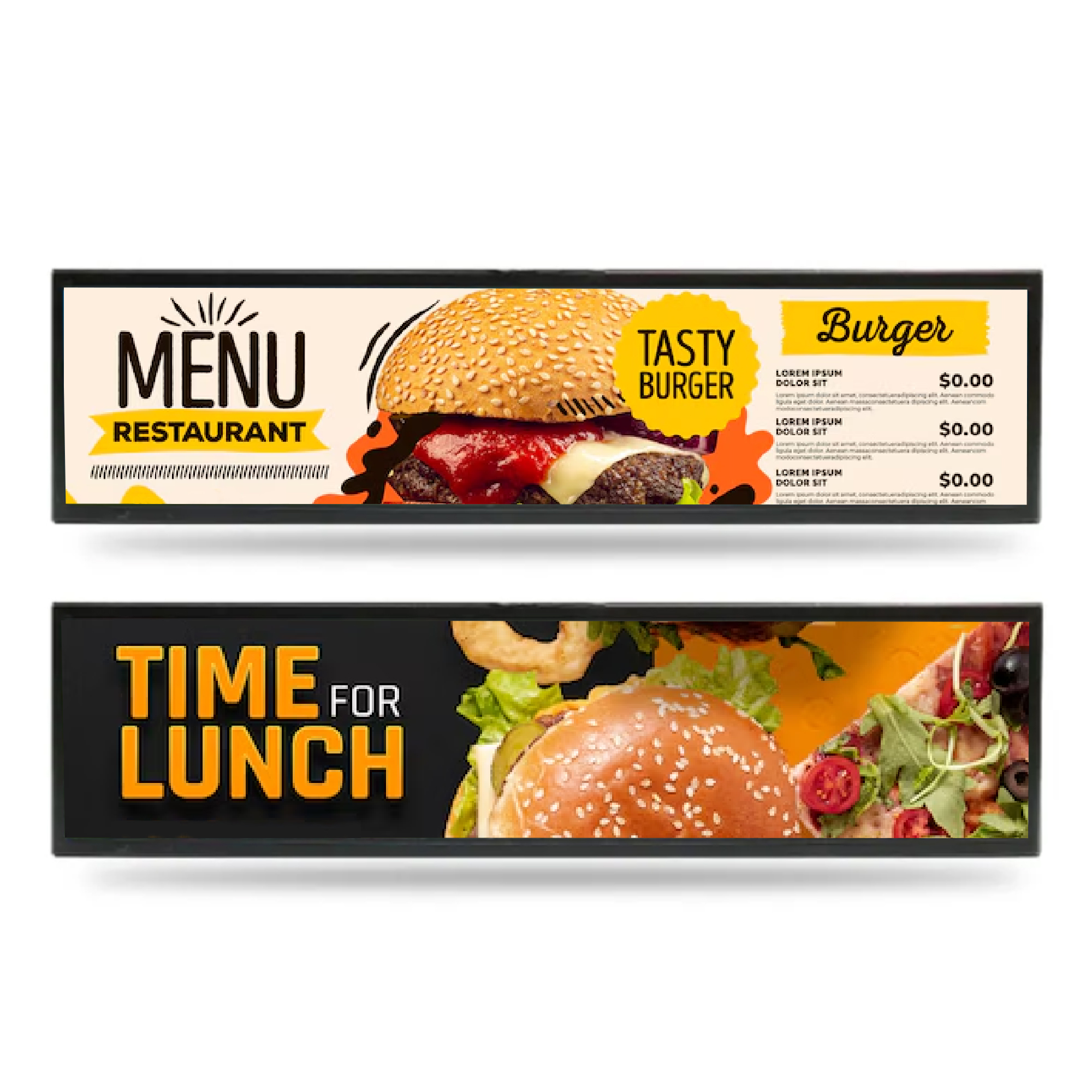
For decades, businesses have relied on printed posters, banners, brochures, signs and static displays to communicate with customers. These traditional advertising methods are still widely used, but in 2026, more businesses are moving toward digital signage to create more dynamic, flexible and engaging communication.
Digital displays allow companies to change content instantly, display video and animations, manage multiple screens remotely and adapt messages to different audiences and locations. For retailers, restaurants, hotels, corporate offices and many other businesses, digital signage is becoming an increasingly important part of the customer experience.
But what makes digital signage different from traditional advertising, and when does it make sense to make the switch?
What Is Traditional Advertising?
Traditional advertising includes physical communication materials such as:
-
Printed posters
-
Banners
-
Flyers
-
Brochures
-
Printed menus
-
Window graphics
-
Static promotional signs
-
Printed price displays
These formats have some clear advantages. They are simple, familiar and often inexpensive to produce for one-time campaigns.
However, traditional advertising also has an important limitation: once the material has been printed, changing the message usually requires producing a new version.
If a restaurant changes its menu, a retailer launches a new promotion or a business wants to update pricing, the existing printed material may need to be replaced.
This is where digital signage offers a major advantage.
What Is Digital Signage?
Digital signage uses electronic displays to communicate information, advertising, promotions and other content to customers or employees.
Depending on the application, a digital signage solution can include:
-
LCD and commercial displays
-
Android digital signage players
-
Interactive touch displays
-
Shelf-edge digital displays
-
Digital menu boards
-
Wall-mounted advertising screens
-
Freestanding digital signage
-
Meeting room displays
-
Ultra-wide displays
-
Smart commercial screens
Instead of printing a new poster every time content changes, businesses can update digital content through software and, in many cases, manage multiple displays remotely.
Digital Signage vs Traditional Advertising
The biggest difference is flexibility.
A printed poster normally displays one fixed message until it is physically replaced. A digital display can show multiple messages throughout the day and can be updated whenever required.
For example, a retail store could display:
Morning: Breakfast promotion
Afternoon: New product campaign
Evening: Special discount
The same screen can therefore support several campaigns without requiring additional printed materials.
1. Dynamic Content Instead of Static Messages
One of the strongest advantages of digital signage is the ability to display dynamic content.
Businesses can combine:
-
Images
-
Videos
-
Animations
-
Text
-
Product information
-
Promotions
-
Prices
-
Social media content
-
Weather information
-
Corporate announcements
This makes communication more visually engaging than a traditional static poster.
Digital displays can also attract attention through movement and changing content, making them particularly useful in high-traffic environments.
2. Update Content Instantly
Imagine a retailer needs to change a product promotion.
With traditional advertising, the company may need to:
-
Design a new poster.
-
Send it to print.
-
Wait for production.
-
Deliver the material.
-
Replace the old poster.
With digital signage, the content can often be changed electronically.
This is particularly useful for businesses with frequently changing prices, promotions, menus or announcements.
3. Manage Multiple Locations
Digital signage becomes even more powerful when a company operates multiple stores or locations.
Instead of sending printed materials to every location, a centralized digital signage system can distribute content to multiple displays.
A retailer with stores in different cities could update a campaign across its network while maintaining different content for individual locations.
This can significantly simplify content management for larger organizations.
4. Better Customer Engagement
Digital signage can communicate more than a static image.
Video, animation, product demonstrations and interactive content can help businesses create a more engaging customer experience.
For example:
-
A restaurant can display high-quality food videos.
-
A retail store can demonstrate a new product.
-
A hotel can promote services and facilities.
-
A showroom can demonstrate product features.
-
A corporate office can display announcements and information.
The screen becomes part of the customer experience rather than simply another advertising surface.
5. Digital Signage Can Support Different Business Functions
Digital signage is no longer limited to advertising.
Modern commercial displays can support many different functions, including:
Retail
Digital promotions, product information, pricing and customer communication.
Restaurants
Digital menus, promotional content and ordering interfaces.
Hospitality
Welcome screens, hotel information, event schedules and guest communication.
Corporate
Meeting room signage, company announcements and internal communication.
Healthcare
Wayfinding, information displays and patient communication.
Education
Announcements, schedules and interactive learning content.
This flexibility allows one display platform to serve different business requirements.
6. Digital Signage Can Reduce Long-Term Printing Dependency
Digital signage requires an initial investment in hardware, software and installation. However, businesses that frequently change printed materials may benefit from reducing their dependence on continuous printing and physical replacement.
Instead of repeatedly producing new posters, businesses can reuse the same display hardware for different campaigns over time.
The economic benefit will depend on factors such as content frequency, number of locations, display size, software and installation requirements, so businesses should evaluate the total cost of ownership rather than comparing only the initial purchase price.
7. Android Digital Signage Adds More Flexibility
Android-based commercial displays are becoming increasingly popular because they can provide a flexible platform for digital signage applications.
Depending on the hardware and software configuration, Android displays can support:
For businesses and system integrators, Android can also make it easier to develop customized solutions for specific projects.
8. Interactive Digital Signage Takes Engagement Further
Traditional advertising is generally one-way communication.
Interactive digital signage allows customers to actively interact with the content.
Touch displays can be used for:
This makes interactive displays particularly useful when customers need to explore information rather than simply view an advertisement.
9. Digital Signage Is Becoming More Intelligent
The next generation of digital signage is moving beyond simple content playback.
Modern commercial displays can be combined with technologies such as:
-
AI
-
Sensors
-
Cameras
-
IoT devices
-
APIs
-
Cloud platforms
-
Remote device management
This creates opportunities for businesses to build smarter environments where displays react to data, location, time or customer requirements.
For example, a digital display could show different information depending on the time of day or integrate environmental data from connected sensors.
Which Is Better: Digital Signage or Traditional Advertising?
There is no universal answer.
Traditional advertising can still be appropriate for simple, low-frequency campaigns where content rarely changes.
Digital signage becomes particularly attractive when a business needs:
-
Frequently updated content
-
Multiple promotions
-
Video and animation
-
Remote content management
-
Multiple locations
-
Interactive experiences
-
Real-time information
-
Integration with other systems
The right solution therefore depends on the business model, environment, content strategy and budget.
Digital Signage for Retail in 2026
Retail is one of the industries where the transition from static to digital communication is particularly visible.
Modern retailers increasingly use displays throughout the customer journey:
Store entrance → Promotional displays → Product information → Shelf-edge displays → Interactive screens → Checkout communication
Digital signage can therefore become part of a broader retail technology strategy rather than simply an advertising tool.
For supermarkets and stores with frequently changing prices or promotions, digital shelf displays can also help reduce the need to manually replace printed price information.
What Should Businesses Consider Before Switching?
Before investing in digital signage, businesses should consider several factors:
Display Size
The correct screen size depends on viewing distance, installation location and content.
Installation
Wall-mounted, ceiling-mounted, freestanding and desktop solutions each serve different applications.
Operating System
Android-based solutions can provide flexibility for applications and customization, while other platforms may be more appropriate for specific projects.
Content Management
Businesses should determine whether they need local content playback or centralized remote management.
Connectivity
Depending on the project, displays may require WiFi, Ethernet, Bluetooth, 4G/5G or other connectivity options.
Touchscreen
Interactive projects may require projected capacitive or other touch technologies.
Customization
For large projects, OEM and ODM customization can allow businesses to adapt hardware, software, branding and mechanical design to specific requirements.
The Future of Business Advertising Is Becoming More Digital
Traditional advertising will not disappear overnight. Printed materials remain useful in many applications.
However, digital signage offers a level of flexibility that static advertising cannot easily match.
Businesses can update content faster, communicate through video and interactive experiences, manage multiple displays and integrate screens into broader digital ecosystems.
For companies looking to modernize their customer communication in 2026, digital signage is no longer simply an alternative to printed advertising. It can become an important part of a complete digital customer experience strategy.
Why Choose a Digital Signage Manufacturer?
Choosing the right manufacturing partner is an important part of a successful digital signage project.
A professional manufacturer can support businesses with:
At BlueShell, we provide customized digital signage and commercial display solutions for businesses, distributors, system integrators and technology brands worldwide.
Our product range includes Android digital signage, interactive displays, shelf-edge displays, meeting room signage, wall-mounted displays and other customized commercial display solutions.
Looking for a digital signage solution for your next project? Contact BlueShell to discuss your requirements and explore our OEM & ODM capabilities.
Explore Digital Signage Solutions
Looking for the right display for your project? Explore our range of Ultra-Wide Stretch Digital Signage, designed for retail stores, shelf-edge applications and other environments where a wide-format display can maximize available space.
You can also explore our Wall Mount Digital Signage, Interactive Digital Signage and other Digital Signage Solutions for commercial applications.


