AI Translation Devices for Business: How Smart Translators Improve Multilingual Communication
As businesses become increasingly international, communicating with customers, visitors and partners who speak different languages has become an everyday challenge.
Airports, hotels, restaurants, retail stores, offices and international events often need a fast and practical way to overcome language barriers.
This is where AI translation devices and smart translator solutions can provide a valuable communication tool.
Instead of relying entirely on smartphones or traditional translation equipment, dedicated smart translation devices can combine a display, microphone, speaker, connectivity and translation software into a purpose-built solution for professional environments.
What Is an AI Translation Device?
An AI translation device is a smart electronic device designed to help people communicate across different languages.
Depending on the product and software platform, a translation device can use microphones to capture speech, process the spoken language and provide translated information through text, audio or both.
For professional applications, the hardware can be designed around the specific environment where translation is required.
For example, a hotel reception may need a compact desktop device, while an airport or exhibition environment may require a larger interactive display.
The goal is simple:
Make multilingual communication faster, easier and more accessible.
Why Are Businesses Using Smart Translation Devices?
Language barriers can create friction during customer interactions.
A visitor may need directions at an airport. A hotel guest may need to explain a request. A restaurant customer may need help understanding a menu. An international buyer may need to communicate with a salesperson.
In each of these situations, communication needs to happen quickly.
A dedicated smart translator can provide an always-available communication interface without requiring employees and customers to install the same application or share a personal smartphone.
This makes smart translation devices particularly interesting for customer-facing environments.
AI Translation for Airports and Travel Hubs
Airports are naturally multilingual environments.
Passengers arrive from different countries and may need assistance with:
-
Directions
-
Check-in information
-
Transportation
-
Facilities
-
Services
-
Travel questions
-
General communication
A dedicated translation device can be placed at information desks, reception counters or customer service points.
A dual-screen design can be particularly useful because both participants can have their own display facing them.
This creates a more natural interaction than passing a smartphone from one person to another.
AI Translation Devices for Hotels
Hotels welcome guests from around the world.
Reception staff may regularly communicate with international visitors about:
-
Check-in and check-out
-
Hotel facilities
-
Restaurant services
-
Room requests
-
Transportation
-
Local information
-
Directions
-
Guest services
A smart translator placed at the reception desk can help staff communicate with guests even when they do not share a common language.
A compact desktop format also makes the device easy to position on reception counters without requiring a large installation.
Smart Translators for Restaurants and Cafés
Restaurants are another environment where multilingual communication is important.
International customers may need help with:
-
Menus
-
Ingredients
-
Food preferences
-
Orders
-
Special requests
-
Payment
-
Restaurant services
A smart translation device can help staff communicate directly with customers.
For restaurants operating in tourist areas or international destinations, this can improve the customer experience and reduce misunderstandings.
AI translation can therefore become part of a broader smart restaurant technology strategy alongside digital menus, ordering tablets and interactive displays.
AI Translation for Retail Stores
Retail stores increasingly serve international customers.
Sales staff may need to explain:
-
Product specifications
-
Prices
-
Features
-
Warranty information
-
Usage instructions
-
Promotions
-
Payment options
A dedicated translation device can provide another communication channel between customers and sales teams.
This can be particularly useful in airports, shopping malls, tourist areas and stores serving international visitors.
For retail environments, smart translators can complement digital signage, interactive displays and other customer-facing technologies.
Smart Translation for Meeting Rooms
International meetings can also benefit from dedicated translation technology.
Companies working with overseas customers, suppliers and partners may need to communicate across language barriers during:
-
Business meetings
-
Product presentations
-
Negotiations
-
Training sessions
-
Conferences
-
Supplier discussions
A desktop smart translator can provide a compact communication solution for smaller meetings where a full conference interpretation system may not be necessary.
Why a Dual-Screen Design Matters
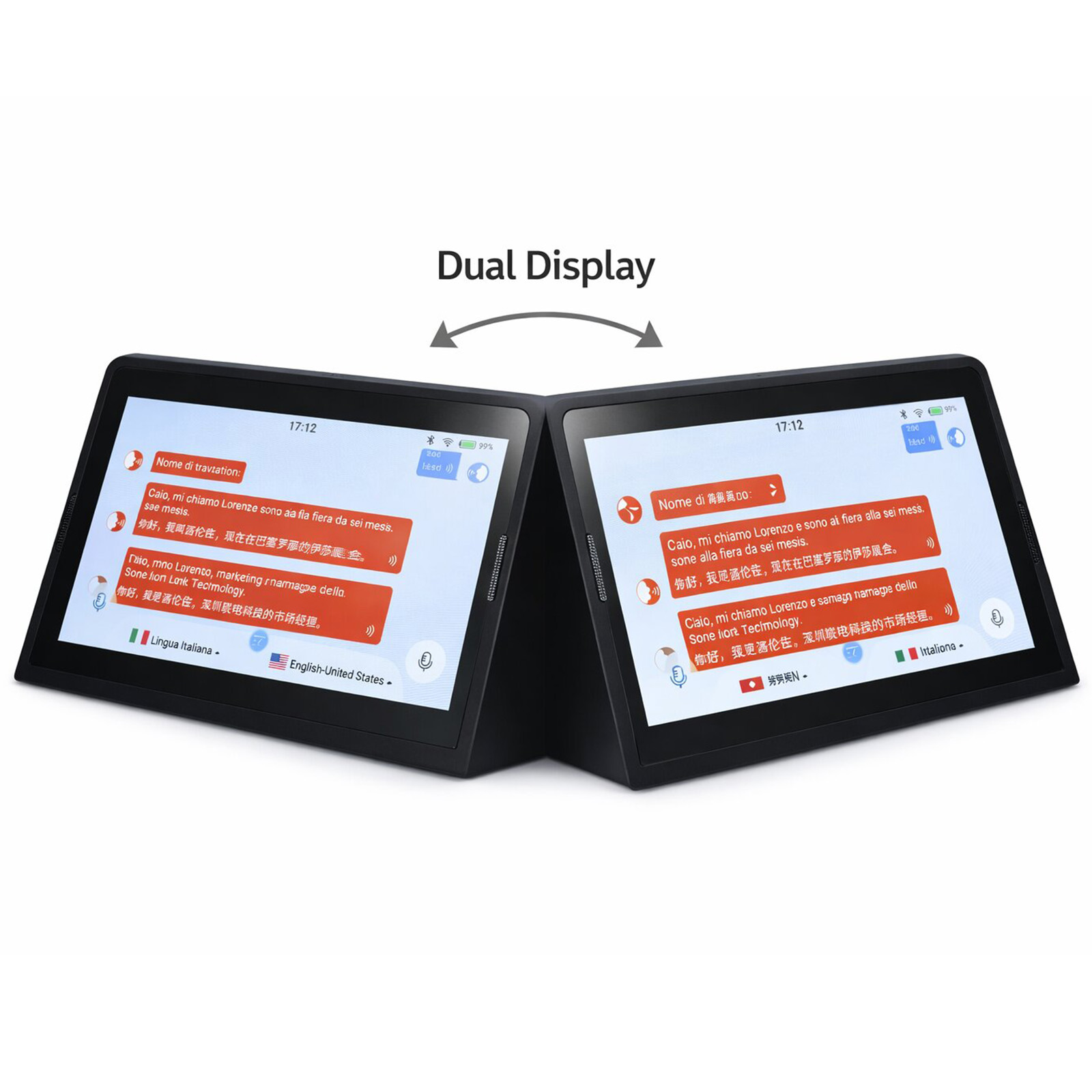
One of the interesting features of a professional desktop translator is the dual-screen design.
With two screens facing opposite directions, both participants can interact with the same device without turning it around.
This can make conversations more natural.
For example:
Customer → Translator → Employee
Each participant can have a dedicated screen while the device handles the communication interface.
This design is particularly suitable for:
A 7-Inch Android Smart Translator for Professional Environments
BlueShell's Dual Screen Smart Translator – 7" Android Display combines a compact desktop form factor with Android hardware, touch interaction, connectivity, audio and battery power.
The device features a 7-inch 1024 × 600 display, touchscreen support, integrated microphone and speaker, Wi-Fi connectivity, Bluetooth 5.0 and an Android operating system. The current product configuration specifies Android 9.0 and support for 121 languages, with language support subject to software updates and configuration.
Its built-in lithium battery provides up to 48 hours of standby time according to the listed specifications, while the device can also connect through Wi-Fi and Ethernet depending on the installation requirements.
[Explore BlueShell's Dual Screen Smart Translator]
Key Features of the Smart Translator
Dual Screens
Two-sided display design allows two people to interact with the device from opposite sides.
7-Inch Touch Display
The 7-inch touchscreen provides a compact interface suitable for desks, counters and reception areas.
Android Platform
Android provides a flexible software environment for smart applications and customized solutions.
Wi-Fi Connectivity
The device supports 2.4 GHz and 5 GHz Wi-Fi for connected applications.
Bluetooth 5.0
Bluetooth connectivity provides additional flexibility for compatible accessories and connected devices.
Built-In Speaker and Microphone
Integrated audio hardware supports voice-based communication and interaction.
Built-In Battery
The integrated lithium battery allows the device to operate without being permanently connected to a power outlet, depending on usage and configuration.
Compact Desktop Design
The desktop stand makes the translator suitable for reception desks, counters, tables and meeting rooms.
Multi-Language Support
The current specification lists support for 121 languages, with the available languages and functionality depending on the software configuration and updates.
AI Translation vs Smartphone Translation
Smartphones are extremely useful translation tools, but dedicated translation devices can offer advantages in professional environments.
Smartphone
-
Personal device
-
Requires users to share or operate a phone
-
Small screen
-
Battery depends on the user's device
-
Designed for many different applications
Dedicated Smart Translator
-
Purpose-built communication device
-
Designed for shared interaction
-
Larger dedicated interface
-
Desktop installation
-
Integrated speaker and microphone
-
Can remain available at a reception desk or counter
Neither approach is universally better.
For occasional personal translation, a smartphone may be sufficient.
For a hotel reception, airport counter or retail environment where translation is required repeatedly, a dedicated device can provide a more consistent user experience.
Where Can AI Translation Devices Be Used?
Smart translation devices can be useful across many industries.
Airports
Passenger assistance and multilingual information.
Hotels
Guest communication and reception services.
Restaurants
Menu explanations, ordering and customer interaction.
Retail
Product information and sales assistance.
Banks and Financial Services
Customer communication at service counters.
Healthcare
Basic multilingual communication where appropriate and where professional interpretation requirements are separately addressed.
Exhibitions
Communication with international visitors, distributors and potential customers.
Corporate Offices
International meetings and visitor communication.
Universities and Education
Communication with international students and visitors.
AI Translation at Exhibitions and Trade Shows
International exhibitions are one of the most interesting applications for smart translation technology.
Trade shows bring together exhibitors and visitors from many countries, often with only a few minutes available for each conversation.
A smart translation device can help exhibitors communicate with visitors who speak different languages.
It can be placed directly on an exhibition counter and used for:
-
Product introductions
-
Basic technical discussions
-
Visitor assistance
-
Lead generation
-
Distributor communication
-
International customer support
For technology manufacturers participating in international events, this can complement digital signage and interactive product displays.
Combining AI Translation with Digital Signage
The future of commercial display technology is not limited to showing advertisements.
Smart displays can increasingly combine:
Display + Touch + AI + Connectivity + Sensors + Software
An AI translation device is a good example of this evolution.
The display becomes an interactive communication tool rather than simply a screen.
This opens opportunities for businesses to create smarter customer-facing environments.
For example, a hotel could combine:
into a connected technology ecosystem.
AI Smart Devices and OEM & ODM Opportunities
Not every business needs exactly the same translation device.
An airport may require different hardware from a hotel.
A retail chain may want custom branding, while a technology distributor may need a private-label product.
This is where OEM and ODM manufacturing becomes particularly valuable.
Customization possibilities can include:
-
Display size
-
Enclosure design
-
Branding
-
Logo
-
Packaging
-
Android configuration
-
Software
-
Connectivity
-
Battery configuration
-
Audio components
-
Mounting options
BlueShell works with distributors, system integrators, retailers and technology companies looking for customized commercial displays and smart devices.
[Explore BlueShell OEM & ODM Solutions]
How to Choose an AI Translation Device for Business
Before selecting a smart translator, businesses should consider several factors.
1. Number of Languages
Check whether the required languages are supported by the software and whether language availability can change through updates.
2. Audio Quality
A clear microphone and speaker are important for voice-based communication.
3. Display Size
The display should be large enough for both participants to comfortably read translated information.
4. Connectivity
Wi-Fi, Ethernet and Bluetooth can provide different options depending on the environment.
5. Battery
For mobile or flexible installations, battery capacity and operating time can be important.
6. Software
Hardware alone does not determine translation performance. The software platform, translation engine and language support are critical.
7. Customization
For large deployments, consider whether the manufacturer can customize the hardware and software.
8. After-Sales Support
For professional installations, technical support and long-term product availability should also be considered.
The Future of AI Smart Devices
AI is changing the role of connected hardware.
Instead of simply displaying information, smart devices can increasingly understand, process and respond to users.
Translation is only one example.
Future AI smart devices can combine:
This creates opportunities for smarter retail stores, hotels, airports, restaurants and offices.
Why Shenzhen Is an Important Manufacturing Hub for AI Smart Devices
Shenzhen has developed one of the world's most mature electronics manufacturing ecosystems.
For companies developing AI smart devices, access to display manufacturers, electronic components, PCB suppliers, mechanical production, software engineering and assembly capabilities can be important.
A Shenzhen-based manufacturer can therefore support projects that combine display technology with computing, connectivity and smart functionality.
BlueShell, the global brand of Shenzhen Link Technology Co., Ltd., develops commercial displays, Android smart devices and customized OEM & ODM solutions for international customers.
[Discover BlueShell's Manufacturing Capabilities]
AI Translation Is Becoming Part of the Smart Commercial Environment
AI translation technology is moving beyond personal travel gadgets.
Dedicated smart translators can become useful tools in places where businesses communicate with international customers every day.
Hotels, airports, restaurants, retailers, offices and exhibitions all have one thing in common:
people need to communicate.
A dedicated AI translation device can help make that communication more accessible while fitting naturally into a modern smart environment.
The combination of Android, dual displays, touch interaction, audio, connectivity and battery power creates a flexible platform for professional applications.
Explore BlueShell AI Smart Devices
BlueShell develops commercial displays and smart technology solutions for international businesses, distributors and system integrators.
Our portfolio includes digital signage, interactive displays, Android commercial displays and AI-powered smart devices.
For businesses looking for a smart translator, AI communication device or customized AI smart display, our team can discuss hardware, software, branding and OEM & ODM requirements.
[View the Dual Screen Smart Translator]
[Contact BlueShell for OEM & ODM Projects]
BlueShell – Smart Display & AI Device Manufacturing
Digital Signage Manufacturer in Shenzhen, China | AI Smart Devices | OEM & ODM Solutions
Since 2012, BlueShell has been developing commercial displays and smart connected devices for customers worldwide.


